


Everyone Wants to Call the Shots
Who should own AI orchestration in the contact center is a question with several potential answers: your customer relationship management (CRM) provider, your contact center platform, an AI specialist, or a hyperscaler. Ask CX leaders today, and you get one answer. Ask what they’re planning for 2028, and you get a very different one.
Little wonder that we’ll see a shift over the next year. Orchestration is moving from niche to mainstream fast. In Metrigy’s Contact Center & Beyond: Elevating CX 2026-27 global study of 626 companies, AI orchestration adoption climbs from 29.2% of companies in 2026 to 44.7% in 2028. The companies getting the best results from AI, what we call the Research Success Group, are moving fastest. We define orchestration as the intelligent coordination of AI, humans, data, applications, workflows, and channels to determine and execute the next-best action throughout a customer interaction or journey. Whichever owns orchestration decides what happens in every interaction and not surprisingly, every vendor category wants that job.
CRM Leads Today, Thanks to Relationships
CRM providers are the top pick to own orchestration (32.3%) today, with AI specialists close behind. CRM already sits at the center of most CX stacks and holds the customer record, so letting it decide the next-best action feels like a natural extension. It’s also the platform most companies call home today.
Companies pick an orchestration owner first on the quality of the existing relationship, ahead of intelligent routing and reasoning, the capabilities that actually make orchestration work. Among companies choosing CRM, the relationship counts even more. Many buyers are picking the vendor they’re comfortable with and hoping the capabilities follow.
Incumbency is fine as a tiebreaker between providers, but I’d say it’s a weak reason to hand over control of every customer interaction.
AI Specialists Tomorrow
Yet many of the same buyers who favor CRM for orchestration today plan to move away from it as their primary platform. By the end of 2028, AI specialists (AI agent and analytics tool providers, which some may also consider to be CRM or contact center-as-a-service (CCaaS) providers that have native AI products,) become the primary customer interaction platform for 48.1% of companies, up from 27.7% today, while CRM drops to 21.2%.
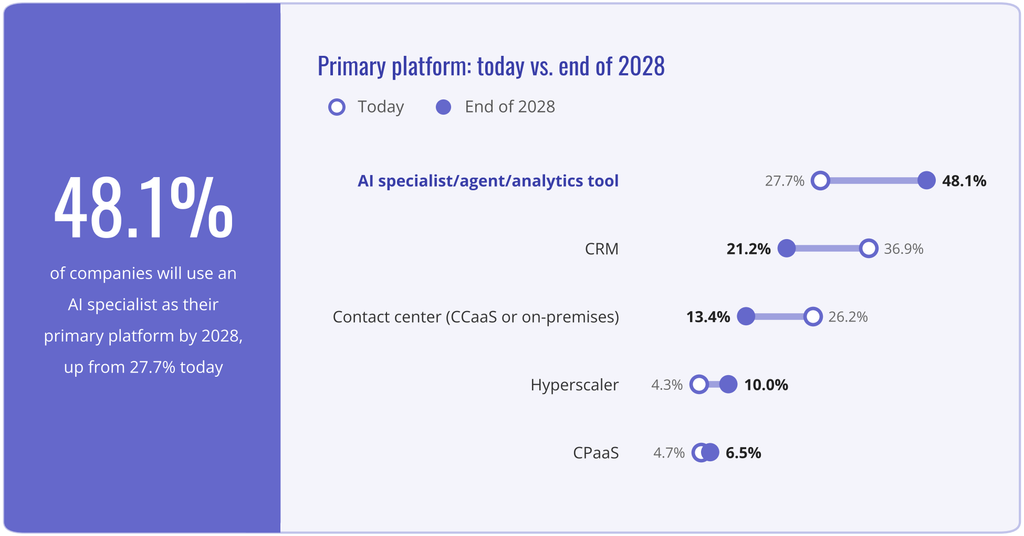
Figure 1: AI specialists become the primary customer interaction platform for 48.1% of companies by 2028; source: Metrigy’s Contact Center & Beyond: Elevating CX 2026-27 (626 companies)
Why switch at all? Technology innovation and the need for better AI reasoning top the list, followed by intelligent routing requirements. More than half of companies picking an AI specialist to own orchestration cite intelligent routing. The Success Group leans this way, too, naming AI specialists as best equipped to own orchestration significantly more often than the Non-Success Group and more often counting one as its primary platform today.
CRM providers should read that as a warning. To keep the customer interaction, they’ll need to compete on reasoning and routing. Undoubtedly, this was one reason behind Salesforce’s move into CCaaS and its recent announcement to acquire Cresta, which brings a specialty in conversation intelligence.
CCaaS providers own much of the information needed to route interactions intelligently. These drivers are good news for those CCaaS providers that have their own native AI platforms (NiCE Cognigy, UJET + Spiral, and, as of recently, Dialpad + Ada, for example), hence the spate of CCaaS acquisitions and mergers we’ve seen in the last year.
CCaaS and Hyperscalers: Lagging, but Not Out
Perception of providers and what they do matters. Fewer than one in 10 companies see CCaaS providers as best equipped to own orchestration, and hyperscalers draw almost no votes. Both trail partners/resellers/integrators and global network providers. As a primary platform, the contact center’s share roughly halves by 2028.
Don’t write off CCaaS, though. The Success Group picks CCaaS providers to own orchestration significantly more often than the Non-Success Group. Companies choosing CCaaS cite intelligent routing, business workflow role, and channels in use—the plumbing orchestration can’t run without. Some of this movement depends on marketing—really! Take NiCE Cognigy as an example. CX leaders who view the company only as a CCaaS provider won’t be as apt to consider them as their primary orchestration vendor as those who view them as an AI specialist. In reality, NiCE Cognigy is both, and both are important. But those considered “AI specialists” are driving the decisions of who will own orchestration.
Hyperscalers’ share as a primary platform more than doubles by 2028. Microsoft and Google top the list of providers best equipped to deliver native CX products, just ahead of Salesforce. Google, Microsoft, and AWS are also among the most used AI platforms for customer service, broadly speaking. Buyers clearly trust these brands, but few see them as orchestrators today.
Build It Into the Core, but Who Sits at the Table?
How companies orchestrate matters as much as which platform does it. Two-thirds say building orchestration into the core of a platform beats orchestrating apps and systems at the edge, and the Success Group is even more convinced. Meanwhile, the open-standards route is early: Fewer than one in five companies use Model Context Protocol (MCP) to connect CX applications today, though more than a third plan to in 2027.
Inside the company, IT owns CX orchestration at nearly half of organizations, while the contact center owns it at fewer than one in five. This is fine, providing the contact center leaders are providing guidance on what they need from orchestration. The function itself is a mix of business requirements and technical design, so coordination between the operational and technical groups are vital.
The obstacles are familiar ones: security and compliance, accuracy of outcomes, and trust of the models. In fact, security/governance/compliance is also the single biggest concern about deploying more AI in the contact center.
What CX Leaders Should Do
Orchestration ownership is up for grabs, and buyers’ own plans show it. Metrigy recommends the following:
- Pick an owner on capability. Score candidates on reasoning and intelligent routing, two of the top reasons companies give for changing platforms.
- Plan for a platform change. With more than four in 10 companies changing provider types within two years, negotiate data portability now so your orchestration logic isn’t locked into a platform you’re about to leave.
- Keep the contact center in the room. IT is the most common owner of orchestration. Pair it with the contact center leaders who know the routing rules, the customers, and the business value.
- Make security the first gate. Security is the top inhibitor to orchestration success, so build compliance and model testing before you scale.
Whichever platform provider wins the orchestration fight will own the customer interaction. Make that decision on purpose, with your 2028 platform plans in mind.


