

The steady drumbeat around generative AI continues as employee experience, customer experience (CX), and workplace collaboration providers lay out their visions and product plans for the technology. Their messaging appears to be falling on eager ears, as evidenced in findings from a recent Metrigy study with CX, technology, and other business leaders at 641 companies.
Understanding of Generative AI is Increasing
For one, less than 15% of study participants said they had little or very little understanding of generative AI, which, for clarity here, is a category of techniques and models that respond to natural language prompts to produce text, images, audio, code, or other media from data that they’ve been trained on. As I wrote previously on WorkSpace Connect, examples of generative AI use cases are plentiful, for all sorts of employees: writing emails, creating marketing campaigns, turning spreadsheet data into presentation graphics, summarizing customer interactions, scheduling meetings among team members, creating employee surveys and capsulizing results in an executive report, and so on.
A slightly greater percentage of our study participants, 20.4%, classified themselves as having a novice-level understanding of generative AI—meaning, they have limited knowledge about the technology, how it works, and how to use it, but they are learning. The greatest portion by far, 65%, said they have an “expert” understanding, with substantial and in-depth knowledge on how generative AI works and how to use it.
Trust in Generative AI Also Increasing
Continue reading at workspace-connect.com.
Virtual assistant, or chatbot, is one of those technologies consumers either love or hate. A chatbot can be a godsend when all that’s needed is a quick answer to a basic question. Go deeper than that and, well, the experience tends to sour.
The problem for many companies has been that they try to do too much with their chatbots all at once, as Metrigy CEO and Principal Analyst Robin Gareiss discusses in a webinar on finding the measurable value of artificial intelligence for customer experience (available on demand). Metrigy’s global Customer Experience Optimization: 2023-24 study with 641 companies shows that chatbots touch 39 of 100 interactions. Out of those, the chatbot resolves roughly 42%—or 16 of 100 interactions.
That’s not a great track record, so it’s not surprising that in surveying consumers Metrigy found that only 13.3% prefer using chatbots over other interaction channels. Better news is that 47.4% will use chatbots in select circumstances—presumably for nothing too complicated. But, a good portion of consumers—nearly 40%—still outright avoid using chatbots today.
Let’s dig into that latter point. Among those who avoid chatbots, most say they stay away from them for two primary reasons. The first, for 62%, is that chatbots don’t understand what they’re asking, and the second, for 62% as well, is that they don’t provide the answers needed. About a quarter say chatbots are too difficult to use, and 28% say using them takes too much time.
These sorts of responses should raise all sorts of red flags for companies. If consumers report that your chatbot doesn’t understand a request, you likely haven’t trained it properly. Perhaps language understanding is an issue, or accents. If a chatbot can’t deliver an answer, perhaps the knowledge base isn’t up to date. If the chatbot is difficult to use, the user interface might need streamlining. And if consumers report that interacting with a chatbot is too time-consuming, then perhaps there’s an issue with branching or response time.
Clearly, most chatbots aren’t yet living up the technology’s potential. But the outlook looks bright. When we asked consumers about their most recent chatbot experience, more reported that being positive (44%) than negative (24%), with 28% saying they considered the experience to be neither positive nor negative. Consumers think chatbots are most useful when they provide information on who the right person is to talk to (48.7%) and for shipping/order confirmations (42.9%), according to our research.
CX leaders can assure their efforts with chatbots get and stay on the right track in a number of ways. For one, they should solicit feedback from consumers on the experience they have with chatbots, and address challenges. They should also consider pairing human agents with their chatbots. Nearly 40% of companies are already doing so, and 52.2% are planning for this structure, according to the CX Optimization study. And, for when chatbots really aren’t the best option for a consumer interaction, they must make the process of escalating to live agent as smooth as possible.
With automated customer surveys, organizations can get data in real time to improve their marketing, sales and customer service strategies. And AI’s role is still growing.
Over 40% of companies run formal voice of the customer programs to obtain feedback, context and insights directly from customers. The results aim to improve everything from agent performance to customer satisfaction to revenue.
CX leaders gather customer insights through various methods, including focus groups, one-to-one discussions, website statistics, social media and surveys. While nearly half of companies use standard surveys, one third use AI-enabled surveys to gather feedback, according to Metrigy’s “Customer Insights and Analytics: 2023-24” global research study.
To automate the delivery of post-interaction surveys, organizations typically use communications platform as a service. Still, AI plays a role in a few ways. It can track when trends emerge from responses in real time and automatically add new branching questions that determine the cause. AI can also read through open-ended responses and draw conclusions.
The role of customer satisfaction surveys in contact centers
Not every contact center uses surveys, but the most successful ones do. They send surveys broadly and after each interaction to gauge feedback on products, services, branding, marketing programs, etc. — anything the company wants.
Contact center leaders evaluate all the responses, and over 60% of those who gather customer feedback act upon it. Most leaders then share feedback with employees. Other actions that leaders take include the following:
Continue reading at techtarget.com.
AI is all the rage now, especially for customer interactions. But how much value does it bring to the organization? We have the hard data on how much AI is changing business metrics. Join the first episode of our CX Optimization webinar series with Metrigy CEO Robin Gareiss to learn about the following:
- How many more contact center agents are needed when AI is not used?
- What types of AI are most widely used in CX, and what value do they deliver?
- How many customer inquiries does AI, and specifically virtual assistants, address?
- How widely used is generative AI, and do businesses OR consumers trust it?
- What do companies spend and save using AI?
CX Optimization Ep.1: Measurable Value of AI for Customer Experience
Presented by: Robin Gareiss, CEO and Principal Analyst, Metrigy
Date: July 11, 2023
Time: 11:00 am ET

The fast pace of generative AI product announcements continues unabated, across each of Metrigy’s core research areas: customer experience (CX), employee experience, and workplace collaboration. Examples from the past week include new generative AI-powered features and functionality from companies like Cisco, Genesys, Glean, NICE, and Twilio.
Are enterprises ready to embrace generative AI, though? For CX use cases, the answer is a solid “Yes,” based on Metrigy’s latest research.
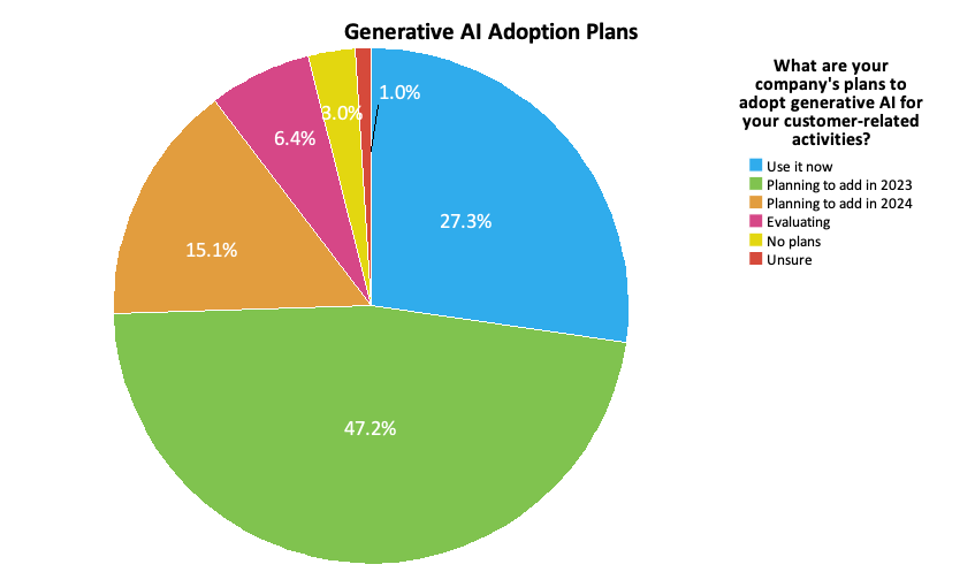
In Metrigy’s Customer Experience Optimization 2023-24 global study, 27.3% of the 641 participating companies are already using generative AI for CX, and 47.2% are planning to do so this year. As expected from this result, a fair percentage have already or plan to add generative AI to their customer feedback (47.4%), contact center (46.2%), and self-service/knowledge management (44.5%) platforms, as well as to their communications platform-as-a-service or other app development platform (40.0%).
For CX, generative AI can lighten an agent’s burden significantly. In some instances, all an agent needs to do is type in a prompt, and the generative AI model spins up a response culled from data it has been trained on. If that data is customer-specific, then so too is the response.
With Conversation Summaries for Cisco’s Webex Contact Center, for example, agents will be able to build a real-time knowledge base of customer interactions and auto-generate chat and call summaries––saving them the manual task. NICE’s new Enlighten Copilot shows another use case: With it, agents receive brand-specific prompts and personalized coaching via a conversational AI that sits alongside them––so to speak––during customer interactions.
Of these and all the various other ways generative AI can be put to use for CX, creating content for a live agent’s use is the most valuable, according to 40% of companies in our study. The next most valuable use is classifying sales and customer interactions (30.8%), followed by auto-summarizations of internal meetings (22.9%) and, also, customer calls (6.4%).
Although most companies trust the use of generative AI either fully or, more so, on a limited basis, about 48% have or expect to put new processes in place to validate the accuracy of information produced by the generative AI. That oversight might be the responsibility of a designated content team, a virtual assistant, a supervisor, or the agents themselves––or a combination of some or all of these.
Clearly, companies are bullish on using generative AI for CX optimization. Nearly 68% even say they have no concerns whatsoever about using the technology.
For a deeper dive on generative AI for CX––including what consumers think of its use for customer service––as well much more on trending CX technologies and strategies, schedule your outbrief on Metrigy’s CX Optimization research study today!
Generative AI offers incredible potential to improve productivity, operations, and security.
At Enterprise Connect 2023 this past March, generative AI was all the rage. Seemingly every vendor on the exhibit floor had a generative AI product or demonstration, and the topic permeated throughout panels and keynotes. Generative AI developments are happening fast — perhaps too fast for many. According to Ray Kurzweil’s “Law of Accelerating Returns,” the rate at which generative AI changes is likely to be exponential – which further suggests that its advances may well bring changes to the collaboration world faster than IT and business leaders can process them.
Leaving aside the discussion of positives and negatives of generative AI, here are six ways that I believe that generative AI will impact workplace collaboration in the near future.
Simplifying and quickening content creation
Prior to Enterprise Connect both Google and Microsoft announced generative AI-based features to enable automated content creation, as did Notion via its Notion AI offering. These features all offer the ability to shave hours off the time required to write documents, create presentations, and analyze data. It’s hard to understate the potential of these features, or the impact they will have on knowledge worker productivity as they reduce time required to create content from hours to minutes.
Continue reading at nojitter.com.
Ask most consumers, and they can rattle off many poor experiences they have had while interacting with a business. Every one of these poor experiences would be better with technology that both empowers customers and assists agents. How do top-tier customer service organizations do it? What technologies and operational processes are crucial to their success?
Metrigy interviewed and surveyed hundreds of organizations and end consumers to discern which technologies matter most. In this webinar, presented by Metrigy CEO and principal analyst Robin Gareiss, you’ll learn:
- What value do customers insights bring to technology decisions?
- How should you use AI today, and what should you plan for tomorrow?
- What are the must-haves for a successful self-service strategy?
- Which applications are supercharging agent productivity?
5 Vital Changes that Will Bolster Customer Success
Presented by: Robin Gareiss, CEO and Principal Analyst, Metrigy
Date: May 16, 2023
Time: 11:00 am ET

The ChatGPT chatbot promises to change enterprise communications, both internally and with customers.
Seemingly overnight, with OpenAI’s December 2022 release of the ChatGPT chatbot, the promise of artificial intelligence (AI) has gone from niche to mainstream use. Any enterprise leaders who haven’t taken notice need to –– this will be a transformational technology for businesses.
As I explained in a research brief, ChatGPT is a large language model (LLM) trained on conversational text to generate human-like responses to any question imaginable in a matter of seconds and ask follow-up questions as needed. These answers can be long, like a detailed business proposal, or short, like an email. In releasing a free version of ChatGPT, OpenAI opened the doors for widespread experimentation using this powerful technology, known as generative AI.
LLMs are not the exclusive province of OpenAI, but the organization gets credit for bringing awareness to the masses. Earlier this month OpenAI released the fourth iteration of its general LLM, GPT-4, with the claim that internal evaluations have shown it to be “82% less likely to respond to requests for disallowed content and 40% more likely to produce factual responses than GPT-3.5.”
For enterprises, the real transformative power of generative AI comes when these models can be trained using internal business data. In theory, enabling employees to use generative AI in their workstreams will lead to big boosts in productivity while also positively impacting employee experience. This theory posits that generative AI will take away the drudge work, leaving them time to focus on more fulfilling creative or business-generating tasks, for example.
Leading companies are levering AI to automate functions that improve customer experience. Our research shows AI delivers measurable improvements to business metrics. Join this webinar to learn the following:
- Which technologies provide the best business metric improvements, in areas including customer ratings, revenue, operational costs, and employee productivity?
- What do customers want automated?
- How can you get budget in your organization for AI technologies?
AI, Analytics & Automation: Step-by-Step Guide to Improving Business Metrics
Presented by: Robin Gareiss, CEO and Principal Analyst, Metrigy
Date: May 3, 2023
Time: 10:00 am ET
Move over full-code communications-as-a-service (CPaaS) platforms, low-code options are the preference today among companies using multiple approaches, according to Metrigy’s recently published Advanced API & CPaaS Development 2023 global research study of 400 organizations.
Low-code options, as well as the even-more-streamlined no-code versions, have popped up over the last couple of years, available from legacy full-code CPaaS providers and new market entrants alike. As a result, CPaaS is quickly morphing from its origin as a rather coding-intensive––yet comparatively agile––way of creating, managing, and deploying communications applications into easy, drag-and-drop exercises requiring minimal, if any, programming expertise.
In our CPaaS research study, available for client access here, we found that roughly 41% of companies are using API services from more than one CPaaS provider. Of those, 55.2% are using a low-code platform and, for 49.8%, this is the primary approach. Meantime, full-code platforms are the primary approach for nearly 31% of companies, and especially among those that have been using CPaaS since its earliest days, and no-code platforms for 19.4%.
Low code comes with three big values, according to at least 52% of those using this option: the ability to improve innovation, lower development costs, and speed time to market. But low code also supports organizational change. For nearly 40%, low code is a boon in that it allows application ownership across functional groups, such as customer experience, customer support, marketing, or sales. And, it frees up developer time for focusing on other high-value work, 26.1% said.
But here’s the rub for CPaaS providers with low-code strategies. We’re starting to see a shift in how companies think about the low-code/no-code spend, presumably as their options grow. In a CPaaS study we conducted last year, companies showed a greater willingness to pay more for these options than they expect to pay now. By percentage, this breaks down to:
68.5% a year ago willing to pay more for low- and no-code functionality vs. 42% expecting to pay more for the same today 17.4% a year ago saying they weren’t willing to pay more vs. today’s 57.9% saying they don’t expect to pay more
Granted, comparing willingness to expectation isn’t exactly apples to apples, but this data is still indicative that companies may no longer be open to paying more with the promise of dev savings over time. Because low- and no-code platforms have become so much more commonplace, they’re less of a differentiator than even just a year ago.


