

In this episode Metrigy President and Principal Analyst Irwin Lazar is joined by Martin Bitzinger, Senior Vice President for Product Management from Mitel to talk about unified communications trends in 2024 and how Mitel is meeting them. We’ll get Martin’s thoughts on a variety of topics including the role of on premises and privately hosted UC platforms, generative AI, the shifting vendor landscape, how buyer expectations are evolving, and much much more.
AI, hybrid work, and security are key focus areas for the next year.
Amazingly, 2024 is upon us. And while the year is certain to be noteworthy due to global events, there are a number of trends related to workplace collaboration that are top of mind. Here are my top five technologies to watch in 2024 (and perhaps beyond?).
GENERATIVE AI
As I mentioned in last month’s No Jitter post, it is no surprise that 2023 has been the year of Generative AI. In 2024 I see three key areas to watch:
- Adoption: Our data shows significant interest in adoption of generative AI companions, assistants, or copilots, depending on whatever terminology you like. But, there are significant buyer-side concerns over cost, ROI, and security. 2024 is likely to be a year where the majority of companies kick the tires, so to speak, on generative AI and figure out benefits versus costs, and how to ensure security and compliance. Ignoring generative AI isn’t an option for companies. Those that do are likely to find that employees have found their own way to use it for their needs.
- Pricing: In 2023 we saw the emergence of two distinct pricing models: Free versus monthly cost. Free models certainly aren’t free for the vendors giving away their generative AI assistants. It costs money to train models and support queries. While it’s understandable that vendors in competitive markets would utilize a free model to gain share and adoption, it’s likely that we see evolution toward a freemium model with free services offering base-level functionality and usage caps, and additional paid tiers of service for those who need/want more.
- GenAI Ops: While much of the attention around generative AI has been focused on personal assistants, to me one of the most exciting areas for gen AI is in improving the ability of IT teams to manage and support apps. I found Cisco’s demo of its AI assistant for Control Hub at its recent Cisco Live event to be especially compelling. As a former network engineer, I can attest to the time and management cost savings that would spring from doing network admin tasks such a configuring a network, troubleshooting networking, and managing those networks via conversational UI instead of a command-line interface or drop-down menu.
MEETING ROOM EVOLUTION
Continue reading at nojitter.com.
Metrigy’s research shows 45.7% of companies using AI today, with a third having it on their 2024 roadmap for deployment or evaluation.
I kicked off 2023 with a post titled “Employee Experience: AI on the 2023 Agenda.” As I stated then, I’d expected to see increased use of artificial intelligence (AI), across a variety of use cases, to improve employee experience (EX). I wouldn’t call myself particularly prescient, but I wasn’t wrong.
With the rise of generative AI into mainstream consciousness (thanks in large part to release of OpenAI’s ChatGPT publicly available conversational search tool), the cloak of mystery around AI has been lifted. Vendors are adding AI—generative and otherwise—to all sorts of products, and many companies are jumping on board.
In Metrigy’s Employee Experience: 2023-24 global research study, conducted in June-July 2023, 45.7% of the 499 participating companies said they were already using or planning to use AI/machine learning (ML) or generative AI for employee experience use cases in 2023. As the following chart shows, 19.2% have adoption of AI/ML planned for 2024 (or beyond) while another 12% were evaluating the technology at the time of the survey.
AI’S TOP VALUE: PREDICTING CHANGES
For most companies (58.7%) already using AI for employee experience, the top value is the ability to predict changes in key business metrics. This is the role of traditional AI/machine learning—i.e., predicting change on a given set of data and then, optimally, act on it.
Consider, for example, the variety of AI capabilities companies could use alone or in tandem to sniff out changes in key factors such as employee satisfaction. This includes, but is not limited to:
Continue reading at workspace-connect.com.
Metrigy’s UCaaS TCO 2023 study provides real-world insight into the operating costs of unified communications as a Service solutions from leading providers.
January 12, 2024 – Research and advisory firm Metrigy has released its Unified Communications as a Service Total Cost of Ownership 2023 research study. Metrigy conducted research with 386 participating firms in the U.S. and Canada in 42 vertical industries.
“Metrigy’s study shows a wide range of costs for licensing, staffing, training, and the use of third-party performance and administrative management tools to support UCaaS,” says Irwin Lazar, Metrigy’s President and Principal Analyst. “IT buyers must carefully consider costs, as well as functionality, in evaluating competing providers.”
Metrigy’s UCaaS TCO study provides real-world insight into the operating costs of unified communications-as-a-service (UCaaS) solutions from leading providers. In addition, this study gathered high-level data on views toward generative AI assistants for collaboration and views toward integrating UCaaS into Microsoft Teams.
Specific topics include:
- Licensing and operational costs for on-premises and UCaaS solutions
- Staffing requirements and costs
- Impact of third-party administrative and performance management platform adoption
- Microsoft Teams Direct Routing and Operator Connect costs
Some key findings in this study include:
- Companies spend an average of $791 per year per license on UCaaS, including licensing, staff, managed services, management tools, and training
- Roughly 80% of companies use the same UCaaS provider for calling and meetings
- This study found that Microsoft is the most represented UCaaS provider among large companies (1,000+) and Zoom is most represented among SMBs (less than 1,000).
- Smaller companies using UCaaS often consider their UCaaS provider to be their MSP since the UCaaS provider manages the platform.
- Companies spend an average of $4,429 per IT employee, per year, in training costs for those who train
This study is available for purchase on our website here.
Generative AI is getting all the attention, but there are other key shifts, like vendor rationalization, which will reshape UC in the months to come.
It has been a transformational year for unified communications and collaboration. Key trends such as rationalization, security and compliance, and support for hybrid work were indeed paramount in 2023. Looking ahead to 2024, these concerns — and others — will reshape the market. Here are my top five UC trends for 2024.
1. Generative AI
Generative AI became the buzzword in 2023. Just about every vendor in the UC (and contact center) space introduced some form of generative AI assistant (or companion) with features ranging from meeting and chat summarization to personal feedback and content creation assistance. Metrigy’s “Customer Experience Optimization: 2023-24: Consumer Perspective” study of more than 500 end-users found that almost half were using generative AI tools as part of their daily work efforts. Going into 2024 I expect two significant areas of focus:
- Defining the business case: Some vendors, like Cisco and Zoom, are giving away their generative AI assistants to existing customers. Others, like Google and Microsoft, are charging extra. For companies to invest in these tools they must analyze the ROI. Typically this will be through measuring gains in productivity, revenue or cost minimization.
- Ensuring security and compliance: Generative AI, as the name suggests, generates content. Examples include the automatic creation of meeting transcripts and summaries, documents, emails and much more. Companies using these tools must manage this content in accordance with governance policies. Regulated companies must ensure appropriate retention while international organizations must adhere to data location requirements for the countries in which they operate.
2. Rationalization
Continue reading at techtarget.com.
From the worlds of customer experience, employee experience, and workplace collaboration, Metrigy analysts talk about what technologies and trends they’ll be keeping up on this year.
Here are eight ways companies that work toward success on EX set themselves apart from their competitors.
Many companies look to company culture as the key to a happy workforce and great employee experience (EX). But engendering a culture that drives positive change in employee metrics such as satisfaction, productivity, and retention takes more than a flex work, a nice café, and a bit of greenery. It requires a feeling of connectedness with each other, across levels, and with the corporate mission—and the right technology choices can help get companies there.
At companies achieving EX success, employees are more engaged. They feel that their feedback is being heard and acted on, which leads them to give greater satisfaction ratings in company surveys. When employees can more easily find and access company and job information, this streamlines their daily activities, resulting in increased productivity. When employees see themselves as valued contributors, they feel more invested in the company, and therefore are less likely to leave, boosting retention.
In Metrigy’s Employee Experience: 2023-24global research study with 499 companies, we asked participants to share percent changes in these success metrics relative to deployment of four EX-related technologies: EX platforms, intranets, voice-of-the-employee (VoE) software, and enterprise search. After determining the mean change for each, and where each company fell, we identified our success group for this study. Of the 189 companies measuring success, 111 qualified as successful.
Use of all of these technologies netted the success group positive change in each of our success metrics — but none more so than an EX platform, as shown below.
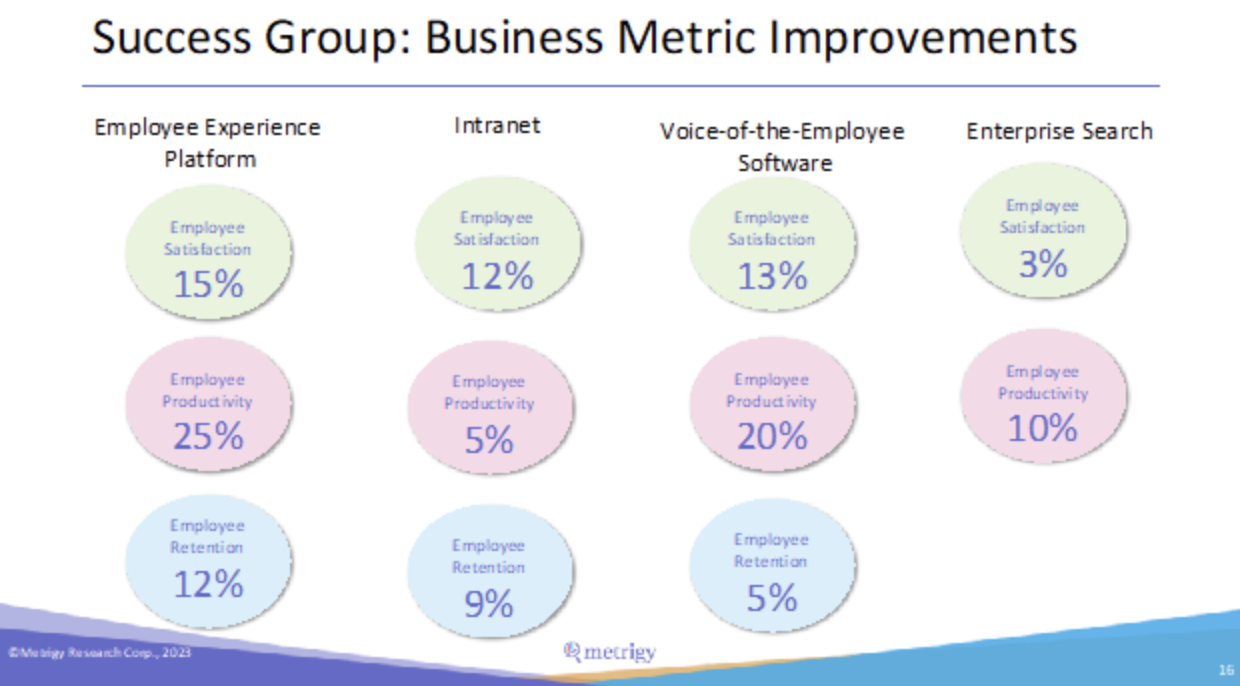
What comprises an EX platform can vary from company to company, but generally this type of product integrates a variety of tools and applications for helping companies centrally manage employee experience. An EX platform typically supports activities such as career development and learning, collaborative goal setting and management, community building among employees, communicating corporate information, performance management, recognition and rewards, VoC/employee listening, well-being management, and more. Of these, the top three activities correlating to success are community building, collaboration goal setting, and recognition and rewards.
EX success isn’t just about picking the right technology, of course. Here’s a look at eight things that successful companies do compared to those that aren’t successful or don’t measure success.
Continue reading at workspace-connect.com.
As vendors rush to bring generative AI companions to market, significant differences are emerging in features, functionality, and perhaps most importantly, pricing. But what are buyers saying about Generative AI? Are they willing to pay for it? Do they see value? In this webinar we’ll share insights from Metrigy’s latest research on how collaboration leaders view Generative AI.
Generative AI Reality Check: What are Buyers Saying?
Presented by: Irwin Lazar, President & Principal Analyst, Metrigy
Date: January 16, 2024
Time: 11:00 am ET

Generative AI assistants have arrived, but adoption, and value are TBD.
If there was a “term of the year” award for the communications, collaboration, and customer experience space, “generative AI” would win for 2023 in a landslide. This past year saw a slew of gen AI announcements from just about every vendor in the market. But, as we hit the peak of the hype curve, there are very real questions about gen AI heading into 2024, answers to which will determine if the hype translates into actual adoption and customer benefit.
WILL COMPANIES ADOPT IT?
Metrigy’s Customer Experience Optimization: 2023-24 – Consumer Perspective study earlier this year of ~500 people in the United States found widespread awareness of generative AI but significant concerns related to privacy, security, and trust. Adoption plans were limited, with just 19.7% saying they would use generative AI for content creation and meeting/chat summarization if available. 16.1% said they would not use it. Almost 41% of participants said that for them to trust gen AI, the technology would require human oversight of content creation as well as limitations on how the tools collect data. Nearly 32% say they will never trust it.
Specific concerns include accuracy of generative AI responses, security of corporate information that may be available to large language models, and privacy of information captured by generative AI tools such as meeting transcripts and interaction critiques.
WHAT’S THE ROI?
As companies get their hands on generative AI assistants they are beginning to focus on ROI, especially when evaluating vendors who charge for AI assistants. We’ve seen in our research over the years that ROI for investments in collaboration applications and features is often difficult to quantify. Some companies look at metrics such as average time spent on repeatable processes to see if they can identify reductions. Other areas may include overall revenue, reduction in costs or staff time, or metrics specific to customer interactions such as first call resolution and customer satisfaction scores.
As generative AI assistants go beyond meeting and chat summarization and transcription, identifying ROI should get easier. For example, employees can identify improvements in data analysis and speed of content creation. IT staff can measure improvements in mean-time-to-repair (MTTR) and administrative tasks from the use of generative AI tools for application and network management.
Even for those adopting free tools there will be some associated costs in terms of user and IT training, IT support, and administration, and to meet security, governance, and compliance requirements for generated content such as meeting transcripts or chat summaries.
DOES IT WORK?
Continue reading at nojitter.com.
Collaboration apps do more than just let employees work together. They also generate a valuable trove of user data that can help companies become more efficient.
Widespread use of collaboration apps has led companies to realize that collecting and analyzing data from them can provide invaluable insight on individual and team behavior. This knowledge, in turn, can help IT leaders make better-informed technology decisions.
The idea of using collaboration app data to better understand employee behavior took root in the global workplace shutdown during the COVID-19 pandemic, as companies sought to understand the effect virtual work left on employee efficiency, productivity and well-being. Today, use of collaboration app data is clearly of interest.
According to Metrigy’s “Employee Experience: 2023-24” global study, nearly 53% of 499 survey respondents said they are currently using or planning to use collaboration behavior data for a wide variety of purposes.
The top uses for gathering collaboration data include the following:
- Examine depersonalized data to determine how teams work.
- Enable HR and other business leaders to understand the behavior of best-performing teams.
- Help underperforming teams improve their effectiveness.
- Understand how employees are using collaboration technology.
- Evaluate ROI, and assess key performance metrics, such as productivity, retention and satisfaction.
The study also examined the companies already using collaboration behavior data to determine which types of decisions the data is most influencing. Here, 52% of companies in general and 63% of the study’s success group — as determined by improvements in employee satisfaction, productivity and retention — responded that they use the data to guide an understanding of technology device requirements. Additionally, 45% of the companies in general and 56% of the success group use collaboration app data to optimize software licensing costs.
Let’s take a look at some questions that companies might answer with the help of collaboration behavior data.
1. Who should receive a webcam or professional headset as part of the standard IT kit?
Continue reading at techtarget.com.


