

In a growing UCaaS market, there are many considerations to make when evaluating which providers best suit your business communications needs.
The unified communications as a service market continues to grow. Nearly 30% of organizations have adopted UCaaS as their primary calling platform, according to Metrigy’s “Workplace Collaboration: 2023-24” global study of 440 organizations. Of those still operating on-premises systems, about 26% were planning on moving to UCaaS while another 21.4% were evaluating doing so in the future.
Those who have already moved to UCaaS systems or are planning to do so are primarily motivated by the opportunity to save money by offloading operational management of cloud communications to a service provider. UCaaS providers control their own platform and are responsible for maintenance and upkeep as well as end user support if a problem arises.
The desire to better support remote work by eliminating the need to carry calls across a VPN into the enterprise network is another major driver for UCaaS adoption. An additional adoption driver gives access to features UCaaS providers may offer, including integrated meetings, contact center and AI-driven enhancements for call management.
Leading UCaaS providers and vendors of 2023
When it comes to picking the right provider, buyers have many choices and factors to consider. Currently, there are at least 30 providers in the market, not including managed service providers who resell and support UCaaS offerings. Some leading providers who either offer their own native services or resell and support UCaaS from partners include the following:
Continue reading at techtarget.com.
In an age of unprecedented speed of change, customer lifecycle management (CLM) is critical for the success of customers and vendors.
CLM typically refers to the entire engagement process between vendors and customers, starting with initial contact but ideally with no end. During the initial phases of CLM, customers and vendors work together to understand business needs and challenges and to identify and implement solutions that support customer goals, such as digital transformation, delivery of new products and services, and/or reduction in operating costs. Over time, the relationship between customer and vendor evolves, with vendors continuing to proactively engage with customers so that they can understand evolving customer needs and align product roadmap and strategy to develop and deliver solutions that meet those needs.
Consider an example of a hospitality organization that initially requires a communications system to support in-room calling, customer reservation management, and hotel operations. Over time those needs may require proactive customer notification via text, integration with in-room entertainment systems to support guest notifications, ordering, and account management and even proactive marketing outreach to make guests aware of specials or upcoming events. To remain competitive, the hospitality organization may use emerging AI-powered tools to improve customer experience and identify and assist in new sales opportunities.
Absent a CLM approach, the customer may not be aware of the ability of their existing communications vendor’s capabilities to deliver advanced capabilities above and beyond what the customer has already purchased or the ability of their on-premises provider to support a move to the cloud with minimal disruption. The result is likely the customer looking elsewhere for additional capabilities, creating a potential loss of the customer for the vendor, along with additional complexity and cost for the customer if they decide to migrate to a new communications platform.
Metrigy’s Workplace Collaboration MetriCast Market Forecast: 2022 study of 935 organizations found that nearly 26% of those operating on-premises unified communications (UC) platforms were planning to change providers, and another 15.3% were evaluating replacing their providers. Primary factors for changing providers include a desire to migrate to the cloud, reduce cost, access new features such as AI and analytics, and converge various collaboration applications onto a single platform. More than 12% said their provider’s roadmap isn’t aligned with their strategy.
How to Create a Successful CLM Program
An effective CLM approach in UC is built on several pillars.
1. Continuous Customer and Vendor Engagement
Continue reading at mitel.com.
UCaaS continues to evolve as more companies use the platform to support meetings, calls and messaging. New features, among them generative AI, could make UCaaS even more important.
There is no question that unified communications as a service continues to gain traction.
Consider: Almost 30% of companies surveyed in Metrigy’s “Workplace Collaboration: 2023-24” global research study of 440 organizations labeled UCaaS as their primary platform for calling, meetings and messaging. Of those using on-premises UC applications, 31% also used UCaaS or planned to do so by the end of 2023.
While a desire to save money is the primary reason for UCaaS adoption, accessing new UCaaS features is another compelling draw for 38% of IT leaders. To that end, here are seven key UCaaS features, in no particular order, that will help boost productivity within your organization.
1. Integrated team messaging
Most UCaaS providers have made team messaging the centerpiece of UX, and for many companies, team messaging is now the primary collaboration UI. Metrigy research data showed that nearly 68% of companies have rolled out team messaging, with 53% viewing it as a hub for work.
Using team messaging as a hub for work also means integrating other applications into it, making the team workspace a one-stop shop for a wide range of resources, including product and task management, business intelligence and CRM. This enables collaboration in context, meaning that employees don’t have to switch out of the team space to pull in a report that they want to share with other team members. Instead, they can chat and act — all within the team space.
Continue reading at techtarget.com.
The UC and CC markets are undergoing rapid change to support hybrid work and the shift to the cloud. To optimize operations and minimize costs, companies must take a proactive strategy for provisioning and change management. In this episode we’ll chat with Micah Singer, CEO of UC/CC management company Kurmi Software about how management needs are evolving, how to best manage multi-vendor, on-prem, cloud, and hybrid platforms and how AI will impact management going forward.
The answer to a successful strategy isn’t forcing people back to the office, it’s ensuring the ability to engage regardless of location.
Hybrid and remote work discussions have turned into a bit of a holy war in recent months with one side arguing for a return to the office, and the other arguing against. Recently, Microsoft executive Lucy Cooper went so far as to argue that employees need to actively fight back against return to office efforts. No Jitter publisher Eric Krapf recently captured some of the recent anti-remote work sentiment here.
Some Drivers of Returning to the Office versus Remote Working
Metrigy’s own data, captured in our global Workplace Collaboration: 2023-24 study of 440 organizations found that just over half (52%) of participating companies are requiring some form of return to the office, with 25.2% bringing back employees on a full-time basis and 26.8% doing so part-time (typically about 2-3 days per week). Those who are returning to the office say the biggest drivers are an inability to perform jobs remotely, as well as the improved informal collaboration available when employees are physically together. Another top driver, often for younger workers, is their own preference to work in an office. For those early on in their careers, in-office work can provide a greater opportunity to develop mentoring and social relationships.
For those sticking with remote work, providing a better quality of life for employees is far and away the top driver. Quality of life benefits of remote work include flexible scheduling, eliminating long commutes, and improved productivity that may come from allowing employees to fit their work into their lifestyle.
At the end of the day, as our data points show, the cat has left the bag with respect to remote and hybrid work. The majority of knowledge workers will work from home at least part of the time, whether by their own accord or due to in-office requirements that only span a few days a week. So the challenge for IT and business leaders is how to ensure employee engagement, no matter the location. When we asked research participants to tell us their biggest challenge in supporting remote and hybrid work “loss of community and culture” was the number one response, even more so than network and application performance issues for remote employees.
Continue reading at nojitter.com.
From improving employee well-being to making smart technology decisions, collaboration behavior insights can help make a difference.
Team chat and video meeting apps bring lots of value to companies beyond the expected “facilitate collaboration.” They improve productivity, boost engagement, and, increasingly, those applications helping companies implement change based on an understanding of employee behavior.
In Metrigy’s “Employee Experience & Workplace Engagement: 2022-23” global research study, 41.7% of the 250 participating companies named understanding employee behavior as a value gained from their collaboration apps. The percentage is even higher, at 55.2%, among the study’s success group, as determined by those companies achieving above-average revenue growth, cost reductions, employee satisfaction improvements, and greater retention based on their use of employee experience technology.
Using Collaboration Behavior Insights to Drive Change
With these data points in mind, I asked collaboration app and management company experts that participated in an Enterprise Connect 2023 panel on collaboration and employee experience to share examples of how their customers have affected positive change or supported strategic decisions based on collaboration behavior insights. From collaboration apps, companies can gather data on areas that include:
- who is collaborating with whom, and how often
- how much time employees spend contributing to rather than just listening in on meetings
- frequency of meeting features and functions such as chat, camera usage, mute on/off, and virtual backgrounds
- average meeting duration
- number of scheduled versus ad-hoc meetings, and so on
When provided to employees on an individualized basis, insights such as these can help guide self-improvement. When provided in aggregate to IT, HR, and team leaders, they can help guide decision making on technology, processes, policies, and more.
Here are some examples of how their customers are using collaboration behavior data.
Continue reading at workspace-connect.com.
On-prem, private hosted, and hybrid Unified Communications (UC) platforms offer unique advantages for education, hospitality, and retail organizations. Among participating companies in those industries in Metrigy’s Workplace Collaboration: 2023-24 global research study, almost 32% use on-premises UC platforms, while 24.7% use a private cloud solution.
Looking at each segment individually, 64.7% of those in the hospitality industry are on-premises or private-hosted, compared to 56.7% of education and 50% of retail. Across geographies, North America has the highest adoption of on-premises platforms, followed by Australia and the EU. Just 13% of those who are currently on-premises plan to move to Unified Communications-as-a-Service (UCaaS) in 2023.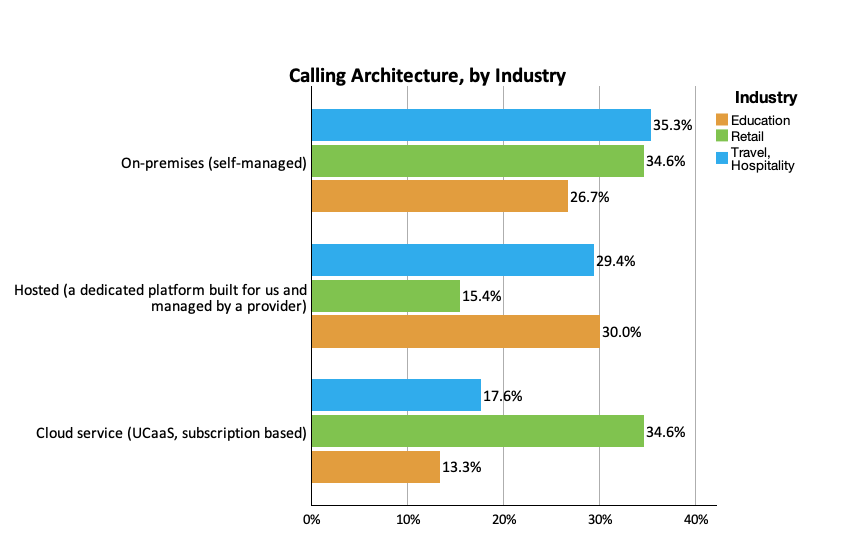
These high adoption rates of on-premises and private hosted UC platforms, coupled with the relatively small percentage of those planning to move to UCaaS, highlight significant benefits for the on-premises, private-hosted, and hybrid models for education, hospitality, and retail industries.
4 Reasons Why Education, Hospitality, and Retail Stick with On-Prem and Hybrid UC
1. Reliability
The primary reason cited across all three industries for staying with on-premises and private-hosted solutions is their reliability. In the retail space, with large numbers of distributed locations, stores must be able to operate even if there is a network outage. Individual locations must be able to place and receive calls and ensure that systems such as alarms can always function. Hospitality operates under a similar model. A hotel, for example, can’t tolerate downtime for its in-room communications or be unreachable by those looking to make a reservation if there is a network outage or a UCaaS outage. Educational organizations, too, must ensure reliability, especially for higher education institutions spread out across campuses, and support communications modalities, including emergency calling systems.
Continue reading at mitel.com.
We are nearing the end of earnings season with calendar first quarter 2023 results wrapping up. For the larger pure-play UCaaS and CCaaS providers, calendar 2023 has started out with positive momentum with earnings up and margins improving. Sales in the Americas are bouncing back nicely while EMEA sales struggle. CCaaS revenue growth is outpacing UCaaS growth as we move through 2023 which is in-line with the forecasts in Metrigy’s MetriCast service. In the CX Metricast study published in March 2023, we have forecast 18% CCaaS revenue growth in 2023. Here are highlights from select providers in order of revenue.
Zoom reported 3% year over year (YoY) growth in fiscal 1Q24 earnings (ended April 30, 2023), to $1.1 billion. Highlights for Zoom include: Zoom Phone reaches 10% of revenue and the online business is starting to stabilize with average monthly churn going from 3.6% in fiscal 1Q23 to 3.1% in 1Q24. 8% growth in the Americas offset 8% decline in EMEA and 5% decline in APAC revenue during the quarter. The Americas region represents 71% share of revenue. Online revenue was down 8% YoY and enterprise revenue was up 13%.
NICE reported 8% YoY revenue growth in its fiscal 1Q23 earnings (ended March 31, 2023), to $572 million. Its cloud revenue grew 25% for the same period and was 64% of total revenue. The Americas region is NICE’s largest, representing 83% of revenue in the quarter, grew 12% YoY. Comparatively EMEA was down 13% YoY (11% of total revenue). Its customer engagement segment was 83% of revenue and up 12% YoY.
RingCentral reported 14% YoY growth in its fiscal 1Q23 earnings (ended March 31, 2023), to $534 million. Subscription revenue which was 95% of total revenue in the quarter increased 16% YoY in the quarter. RingCentral noted slower upsell to existing customers due to macroeconomic conditions. Overall ARPU remained steady at slightly above $30. Operating margin has improved significantly to 17.2% (compared to 10.4% in 1Q22). Maintaining FY 2023 guidance of 10-11% revenue growth.
Five9 reported the strongest YoY growth at 20% in its fiscal 1Q23 (ended March 31, 2023), to $218 million, exceeding expectations. Five9’s growth stems from strength in its enterprise business with subscription revenue grew 31% YoY, accounting for 85% of revenue. International revenue grew 48% YoY – but only 10.6% of total revenue.
8×8 reported 2% YoY growth in its fiscal 4Q23 earnings (ended March 31, 2023), to $177 million. The Fuze business represented 14.6% of the total revenue. Its total annual recurring subscriptions and usage (ARR) was $687 million at the end of the quarter, up 33% YoY. 8×8’s enterprise class of customers (defined as customers representing >$100K of ARR) is 57% of total ARR, a segment 8×8 is focused on growing.
Optimizing employee experience has become mission critical for companies crafting new workplace strategies and seeking to improve key business metrics, including productivity. Oftentimes, however, employee experience management assumes employees have ready access to corporate desktops and applications and can move about digitally at will. In other words, they fail to distinguish between knowledge workers and frontline workers, instead expecting a single set of employee experience processes and tools to work well for both. This is a mistake.
In this webinar, hear how successful companies are addressing the frontline worker challenge, based on Metrigy’s latest research, and discover how to boost the experience for these employees with the right tools and technology based on insight from digital workplace solutions experts at Unisys. You’ll come to understand the unique requirements of frontline workers, what data to gather for generating valuable insights, and what processes to put in place to facilitate experience management and drive business improvements.
Solving the Frontline Worker Challenge with EX
Presented by: Beth Schultz, Vice President of Research and Principal Analyst, Metrigy
Stephen Tong, Head of Product, PowerSuite, Unisys
Stacy Harder, Solution Manager, Seamless Collaboration, Unisys
Bobby Arbuthnot, Director of Solution Management, Employee Experience, Unisys
Date: June 27, 2023
Time: 11:00 am ET

Metrigy’s Workplace Collaboration: 2023-24 global study of 440 organizations find substantial deployment of on-premises and hosted unified communications platforms within financial services and healthcare industry participants. Nearly a third (32.3%) of financial services firms are deployed on-premises compared to 37.5% of healthcare organizations. An additional 22.6% of financial services firms use single-tenant private hosted cloud solutions, as do 12.5% in the healthcare vertical.
Among these participants, we find that on-premises adoption is highest in the EU, particularly within France, Germany, and the UK, compared to the US and Canada. And just 9.1% of financial services and healthcare industry participants plan to move to multi-tenant Unified Communications-as-a-Service (UCaaS) in 2023.
Why Healthcare and Financial Services Stay On-Prem or Hosted
Healthcare and financial services participants cite the following reasons for staying with an on-prem or private hosted cloud.
Cost Savings
Nearly 78% overall, including 83.3% for healthcare and 66.7% for financial services, say that lower operating costs for on-premises and private hosted platforms are a driver for staying with their current architecture. For these institutions and organizations, the cost of maintenance, support, and service contracts is less than that of moving to a UCaaS per-seat subscription model, especially when existing platforms are fully paid for and depreciated.
Continue reading at mitel.com.


