

In this episode, find out which providers are Top 10 in Metrigy’s annual UCaaS MetriRank report. Senior Research Director Diane Myers walks us through the rankings, and provides her guidance on the market.
For the last several years Metrigy has tracked compliance with key 911 regulations including Kari’s Law and RAY BAUM’S Act. In addition, we are now tracking adoption of Next Generation 911, which promises to bring improved data sharing with first responders, and optimized location management.
911 Compliance
In the US, the two major laws governing 911 are Kari’s Law and RAY BAUM’S Act.
Kari’s Law, which became effective for new installs and sales of multi-line telephone systems on February 17, 2020, requires that phones be able to call 911 without requiring dialing of a prefix. Kari’s Law was inspired by the tragic story of Kari Hunt, who lost her life via domestic violence while her child tried to dial 911, but could not because the child did not realize that they first needed to dial an “9” to get an outside line. In addition to direct dial of 911, Kari’s Law requires that appropriate personnel are notified in the event of a 911 call, and that any phone calling 911 must be able to receive a call back.
RAY BAUM’S Act, which is an acronym for “Repack Airwaves Yielding Better Access for Users of Modern Services” is named after late former Congressman Ray Baum, a figure deeply involved in telecom policy throughout his career. RAY BAUM’S Act requires that calls to 911 provide a “dispatchable location” allowing first responders the ability to respond to the location of the call’s origin. RAY BAUM’S Act went into effect for fixed line phones on January 6, 2021 and for non-fixed phones (e.g. softphones) a year later.
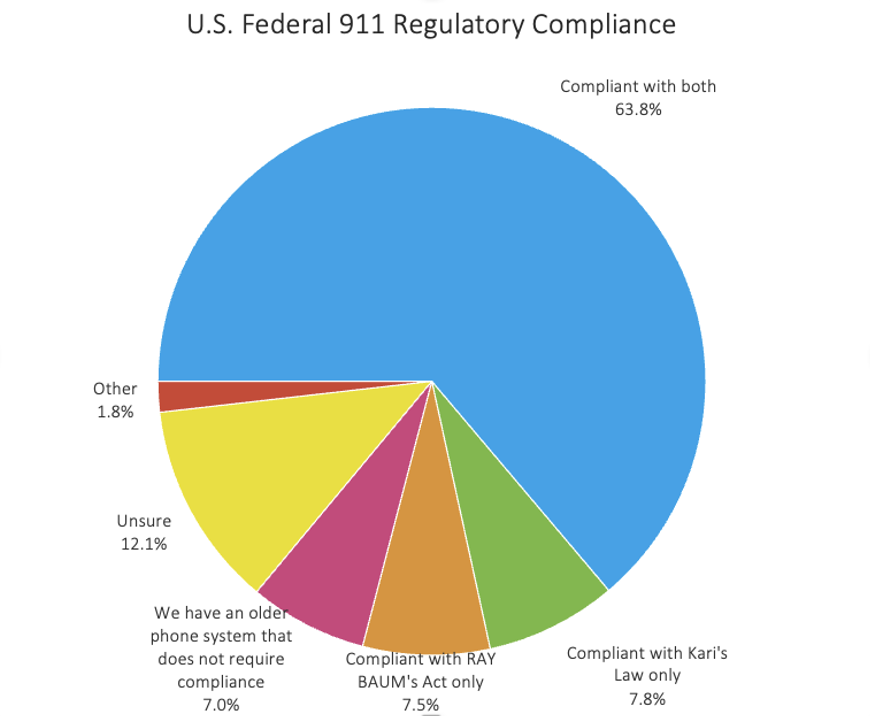
Despite the fact that almost half a decade has passed since these laws went into effect, Metrigy finds that organizations still struggle with achieving compliance. In our Employee Engagement: 2025 research study of 400 organizations, published in November of 2024, we found that just 63.8% of participating companies said that they had achieved compliance with both laws, a slight increase from the 62.7% who reported compliance in 2023. Participants cite a number of reasons for not being compliant, including a belief that older systems do not require compliance, and confusion over what it means to be compliant. Lack of compliance raises risks of harm to employees,reputation, and financial loss and should be promptly addressed by IT and business leaders in consultation with appropriate legal counsel.
Alyssa’s Law Emerging
In response to the mass shooting at Marjory Stoneman Douglas High School in Parkland, Florida in 2018, a group led by the parents of one of the victims, Alyssa Aladeff, launched a nationwide effort to require classrooms to have silent alarms that teachers can activate in the event of an emergency. Activating these alarms triggers a call to 911 with appropriate location information, as well as to security stations within the school. Today, 8 states have enacted a version of Alyssa’s Law, with consideration underway in more than a dozen additional states. While we haven’t yet researched compliance, we do advise our clients to be aware of Alyssa’s Law efforts within the states where they operate.
NG911 Becomes Reality
Next Generation 911 has been under development by standards organizations for several years. It provides the ability for organizations to share additional data including alarm and sensor info, camera feeds, floor maps, locations of critical infrastructure, and so on with first responders. It also allows for endpoints to use available resources, such as network devices and GPS, to identify their location and transmit it in real time to emergency call centers. NG911 adoption today is limited by the ability of emergency call centers to support it, and by an enterprise’s phone system to leverage it. Our recent study showed a high level of awareness and growing adoption, with 42.1% of participants planning to implement NG911, and another 27.6% at least familiar with the technology.
Bottom Line
Achieving 911 compliance is a matter of critical workplace safety. And, NG911 will improve the ability to deliver a safe working environment via improved information sharing with first responders. Service providers, consultants, implementation partners, and enterprise telecom leaders should all take a proactive approach to ensuring compliance and readiness for emerging next-generation technologies.
Does the concept of a connected workspace for collaborative work finally have legs?
Giving employees a digital “place” to call home is a recurrent theme in IT, especially among those of us with communications and collaboration top of mind. I’ve talked about it myself many times over the years, on these pages of No Jitter as well as from the speaker’s podium at Enterprise Connect.
In the last few years, the rapid rise and continued widespread support for work from home or hybrid work has lent more gravitas to the goal of creating this digital home. For one, the use of cloud apps has exploded, which means some employees end up spending far too much time throughout the day clicking their way among them. For another, employees should be able to collaborate with each other, regardless of where they’re geographically located, with ease. And, yes, video meetings and team chat apps achieve this purpose—but only to a certain extent. More is needed.
Enter the latest iteration of the digital hub, what Metrigy likes to call a connected workspace for collaborative work. This is the place employees click into at the start of their day and, if done well, will not need to leave until they sign out at night. From this connected workspace, employees can find information and people they need to accomplish work, communicate about/collaborate on their projects, automate different processes, and manage their work.
Continue reading at nojitter.com.
My sessions this year focus on different areas of governance and compliance.
Here we are again: Another Enterprise Connect is almost here! This year I’m excited for the opportunity to continue some of the conversations that we had at last year’s event and provide our audience with actionable guidance and insights. I am leading the following sessions:
- Best Practices for Implementing NG911 on Wednesday from 9:00am – 9:45am
- Overcoming Security and Compliance Challenges in Generative AI on Thursday from 8:00am – 8:45am
In addition to those two, I am participating as a panelist on the Thursday General Session from 10:00am – 11:00am as we discuss: Have We Arrived at the Future of the Workplace Yet?
Preparing for NG911
Continue reading at nojitter.com.
A structured approach requires detailed cost-benefit analysis.
Last month on No Jitter I shared insights into how companies are measuring ROI for their adoption of generative AI collaborative assistants. In this month’s post, I want to dig a bit more into the methodology for assessing generative AI’s value.
Building the Organization
Continue reading at nojitter.com.
Most enterprises lack sufficient collaboration security strategies. Instead, companies are disabling features to improve security. Learn which features are most often disabled and why.
Vendors continually roll out new collaboration applications, using technologies such as AI to gain competitive advantage even as they deliver new features, among them connected workspace applications.
The torrent of products, however, creates collaboration security challenges for those responsible for governance, security and compliance. They must ensure that any new app or feature introduced to the workplace is done so in a manner that minimizes risk. At the same time, any failure to proactively support new collaboration capabilities may result in employees using tools outside of IT control.
Companies react to attacks on their collaboration apps
Continue reading at techtarget.com.
From agentic AI to workplace of the future, here are a few of the technologies and trends Metrigy will be exploring in 2025.
Multivendor phone systems can present challenges for E911 management. Third-party platforms, however, can help businesses with call routing and location management.
In the United States, E911 management has two core requirements: ensure calls placed to 911 from company phone systems reach the correct emergency communications center or public safety answering point and ensure accurate location information associated with the phone number originating the 911 call.
Multiline telephone systems might require compliance with two federal regulations: Kari’s Law and RAY BAUM’s Act.
Kari’s Law covers multiline telephone systems sold, leased or installed after Feb. 16, 2020. It requires that all phones can dial 911 directly without needing a prefix, such as 8 or 9, to reach an outside line. It also requires that appropriate personnel, such as on-site security individuals, are notified whenever a 911 call is made. And it mandates that 911 calls sent to an emergency communications center (ECC) or public safety answering point (PSAP) provide a valid callback number so the operator can reach the caller if the call is interrupted.
Section 506 of the Repack Airwaves Yielding Better Access for Users of Modern Services Act of 2018 (RAY BAUM’S Act) requires that calls placed to 911 provide a “dispatchable location.” The Federal Communications Commission defines a dispatchable location as “a location delivered to the PSAP with a 911 call that consists of the validated street address of the calling party, plus additional information such as suite, apartment, or similar information necessary to adequately identify the location of the calling party.”
At a minimum, a dispatchable location is usually defined as the main entrance to a building, but it could include more specific location information.
Overcoming multivendor E911 challenges
Continue reading at techtarget.com.
A look back at some of the key trends in POTS, Gen AI security and workplace collaboration, as well as some insights on potential trends in 2025.
No Jitter asked frequent No Jitter contributor Irwin Lazar, president and principal analyst at Metrigy, for his thoughts on a few topics and trends in 2024, ranging from what happened with POTS, to the use of generative AI in collaboration tools, as well as what trends may emerge in 2025.
No Jitter (NJ): What happened with POTS in 2024? Anything major or more of a continuing trend? Do you expect anything ‘radical’ in 2025?
Irwin Lazar (IL): The POTS market continues to undergo change as some countries push to force carriers to retire their POTS services, while others deregulate to allow carriers to raise prices, or to decommission services. Our Employee Engagement Optimization: 2025 global research study found that about 38% of those still using POTS are planning to retire it, either via transition to VoIP or to wireless services.
(Editor’s note: For more, check out Lazar’s article on POTS lines.)
NJ: You’ve written about Gen AI security and workplace collaboration security. What’s important to highlight at year-end for readers?
Continue reading at nojitter.com.
Metrigy’s connected workspace research shows that about 62% of companies studied already are supporting or planning to support AI functionality for collaborative work management (CWM). In this episode, Urmila Kukreja, director of product management for CWM provider Smartsheet, talks with us about the pragmatic use of AI for CWM, and more.


