


From rogue AI agents to power-hungry data centers, the third quarter of 2026 brought a steady stream of bad press about AI. If negative headlines shaped how consumers feel, we should have seen their satisfaction with AI-powered customer service drop. It didn’t.
Metrigy’s AI Consumer Experience Index study, conducted in partnership with NiCE, measures how consumers rate their customer service experiences, including interactions with AI, against a first-quarter baseline of 100 across eight sub-indexes, such as satisfaction, trust, and empathy. In the third quarter, the overall index came in at 102.7, easing 1.9 points from the second quarter but still 2.7 points above baseline. Two sub-indexes are holding it up: AI Satisfaction (109.4) and AI Trust (106.9), the only ones scoring more than six points above baseline.
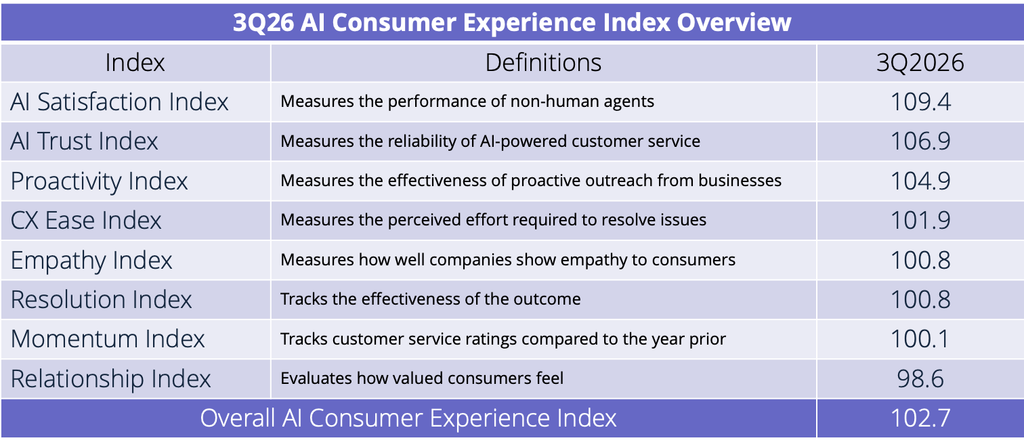
Table 1: 3Q26 AI Consumer Experience Index Overview
But being satisfied with AI doesn’t mean consumers are ready to hand it everything. Of the 1,000 U.S. consumers we surveyed, 71.2% say they’d choose a human over an AI agent, even when resolution is guaranteed. That isn’t an outright rejection of AI. It reflects the specific expectations consumers bring to AI interactions, and companies must understand those expectations to keep earning consumers’ trust and, in turn, increase their appetite for AI.
Understand me the first time
Among consumers who prefer a human agent, the top reason is that AI doesn’t understand them (selected by 28.0%). As one consumer shared, “AI only picks up keywords, and if you don’t word something correctly, it is not helpful.” We’ve all been there, trying to put into words the reason we’re calling, while the company’s AI doesn’t pick up a word we’ve said, or routes us in completely the wrong direction.
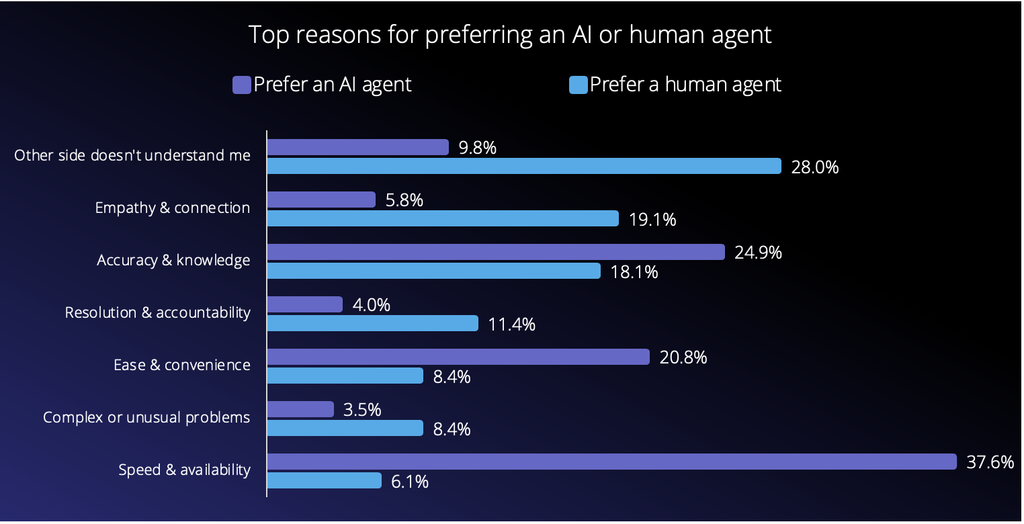
Figure 1: Top reasons for preferring an AI or human agent
The primary expectation is that the AI agent will be lacking comprehension. For companies that understand this, it is absolutely fixable. They can work to change this expectation by improving intent recognition, better enabling AI agents to handle multi-part questions, and maintaining contextual awareness across channels, for example.
Fewer bad experiences are increasing trust
Overall, consumers are having fewer bad experiences. AI Satisfaction’s gain since the first quarter came from the bottom of our five-point rating scale, which runs from much worse than expected to much better than expected. The share of consumers rating their AI agent experience much worse than expected fell from 10.6% in 1Q to 7.0% in 3Q, while the top rating stayed relatively unchanged. Most of that shift went to the middle of the scale, with more consumers saying AI landed about where they expected.
Our other AI sub-index, AI Trust, shows that trust is creeping up. The share of consumers who trust AI-powered systems a great deal rose from 16.5% in 1Q to 17.9% in 2Q to 18.5% in 3Q. The takeaway here? Fewer bad experiences appear to be driving steady trust gains. And with patience shrinking (the average consumer now tolerates only 2.8 bad experiences before leaving, down from 3.1 in 2Q), one failure costs more than one great interaction earns. That makes reliability and trust worth a company’s focus.
Give me a clear way out
To keep trust and satisfaction with AI-powered customer service on the rise, it’s important to give consumers a clear exit path. According to the study, 35.4% of consumers want a live-agent option offered immediately when contacting a business, and 31.0% want it as soon as the system doesn’t understand them. Only 5.1% of consumers don’t expect or need access to a human agent.
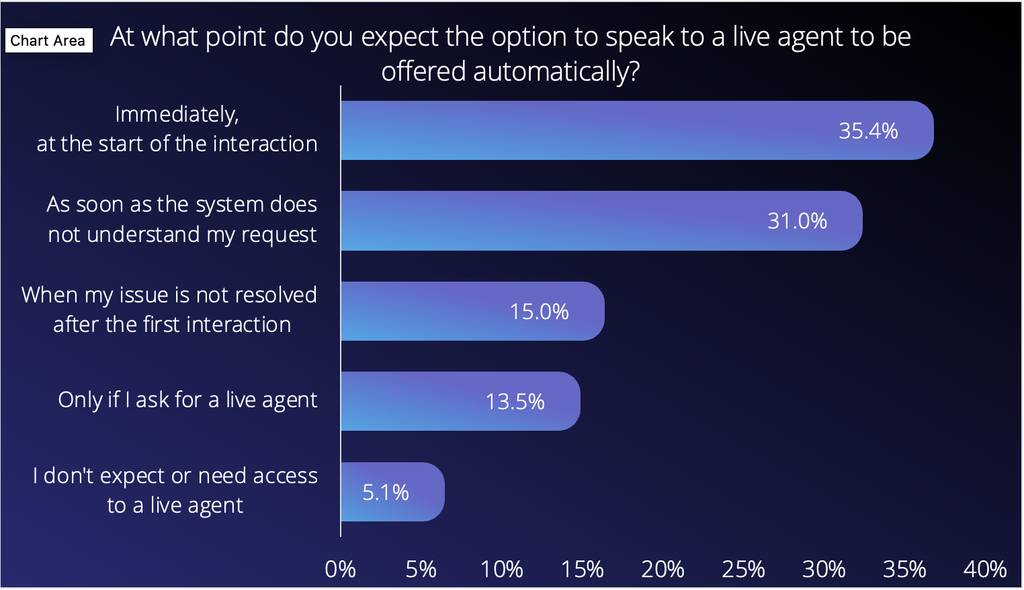
Figure 2: At what point do you expect the option to speak to a live agent to be offered automatically?
Consumers will try AI, especially if they can see the exit. This is an area where companies can build credibility for their AI-powered customer service. Let them try the AI agent, make sure it works seamlessly, and build on that trust and positive interaction. If it doesn’t work for the consumer, for whatever reason, the handoff, with context carried over so they don’t have to repeat themselves, is now essential to meeting consumers’ expectations.
Know when a person should handle it
That said, there are some instances where AI-powered service is simply not the best use of a company’s time and dollars spent. The issues that consumers say should always involve a human include money (billing or payment disputes, 49.4%, and money lost or charged incorrectly, 46.6%), complex or multi-step problems (46.7%), complaints (45.9%), and personal or sensitive information (44.0%).
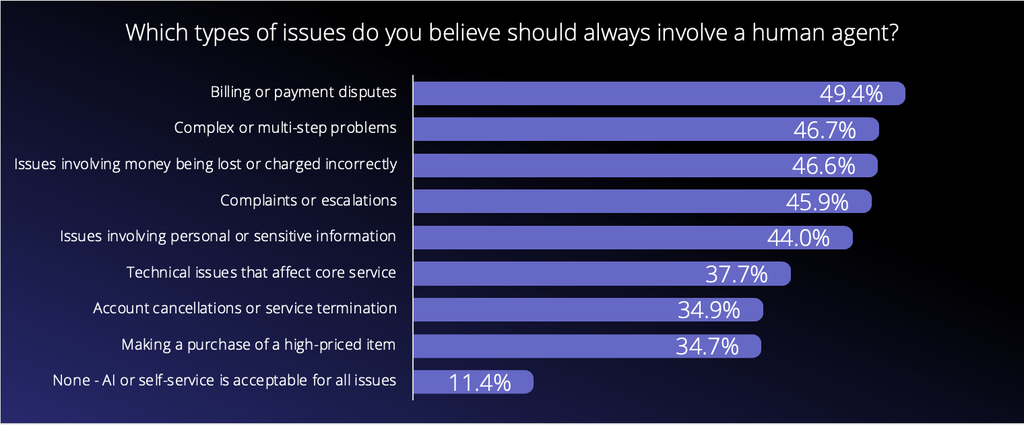
Figure 3: Which types of issues do you believe should always involve a human agent?
Only 11.4% of consumers say AI or self-service is acceptable for all issues. The best way to address this is by routing calls by stakes, not just by volume. When a customer calls in for a billing issue or a complaint, routing that call right to a human who can empathize with and assure the caller that their issue is heard will go a long way. We asked consumers what their ideal customer service experience would look like, and the largest group (39.4%) said a mix of AI and humans, switching automatically based on complexity. Consumers recognize that there are appropriate times for both AI and human agents, rather than one or the other for every issue.
Be fast, and be right
Accuracy is the top reason consumers choose their preferred channel (54.7%). And among those who prefer AI, 37.6% cite speed, no wait, or constant availability as the reason they choose an AI agent. Speed and accessibility are what win people over to AI, but a wrong answer will lose them. Keeping in mind that dwindling tolerance, and that 57.9% of consumers leave a company after just two or fewer bad experiences, it’s imperative that companies provide AI-powered service that is not only quick, but more importantly, accurate.
What this means for CX leaders
Consumers are telling us what’s working well, and what to keep an eye on. To maximize AI-powered customer service efforts, CX leaders should consider the following:
- Invest in comprehension before personality – You could deploy the world’s friendliest AI agent, but if it can’t understand what your customers are saying, it leaves consumers with the same bad experience, begging for a human who can understand them. Make sure your AI’s comprehension is top-notch.
- Make the path to a human visible and the handoff seamless – Consumers will have a better experience knowing that they have a direct path to a human if things go poorly with the AI interaction. Make that handoff available, and make sure the consumer doesn’t have to repeat themselves once they reach the human.
- Route money, sensitive, and complex issues to a human by default – Let humans handle these high-stakes topics for the best customer service.
- Measure first-contact accuracy, not just containment – Most AI programs are judged on containment, the share of interactions handled without a person. But a customer who gives up and calls back tomorrow counts as contained, too. Track whether AI got it right the first time, and whether customers come back about the same issue.
Consumers have a straightforward ask of AI: Understand me, get it right, and let me reach a person when I need one. Companies that meet it will find consumers more willing to use AI than the headlines suggest.
For more on the study, see the full report here.


